
Little Nothings
I’m in the process of charting a path for my art, creative growth, and reputation which is based in part on a surprising thing called Schubert’s Beethoven Project, a book by John Gingerich. His theory is that Schubert knew he could become the next Beethoven, so he plotted his career advancement by striving for “the highest in art,” upping his personal ante for creative musical potential, working in the genres that Beethoven ruled over, and making chess moves in his networking to reach the ultimate goal of receiving a glowing critical reception of his biggest symphony to date...and many more to come. Of course Schubert didn’t live very long, and died before his last big symphony could be heard in public. Even though this all happened in the 1820s there is still relevance to this idea even today. A well thought out strategy is absolutely imperative to artistic success and always has been, but equally important is the ability to pivot that strategy.
Because of my intense interest in Viennese classical music I decided this would be a fun way to create my own strategy adapted for a visual artist living in Seattle today. In many ways I see Seattle now as similar to mid 19th century Vienna. We had our moment of being the world’s musical capital back in the 1990s, and tons of musicians moved here because of that. That star is now declining, but the reputation remains. We’re also total snobs about coffee and practically everything else, in a word very Viennese. Seeing as I live in this sort of neo-classical-Vienna I decided to embark upon Juliana’s Beethoven Project.
It begins with these 7 collages I call Little Nothings. They are visualizations of Beethoven’s first set of bagatelles, opus 33. A bagatelle is a word of possibly French or Italian origin meaning something very minute and unimportant. Beethoven actually called them Kleinigkeiten, which means little nothings. These are pieces that he loved composing all his life, often while in the middle of working on much bigger things. Beethoven treated bagatelles as his low pressure musical laboratory, a place to experiment and get weird on a small scale.
I too treated these collages as artistic experiments in new (to me) techniques. I want to start working more with my own patterned papers, but I still have a lot of old scrapbook papers that I want to use up, so I decided to use them in these pieces. The Little Nothings are the jumping off point to a big Beethoven year, 2027 being the 200th anniversary of his death. My plan is to spend 2027 working on triptychs for all 9 of his symphonies, but before I get to that there will be a project visualizing his last string quartet, as well as Schubert’s. I’ll have more to say about what I call The Last Quartets later.
Here is a little bit about each piece in the Little Nothings series:
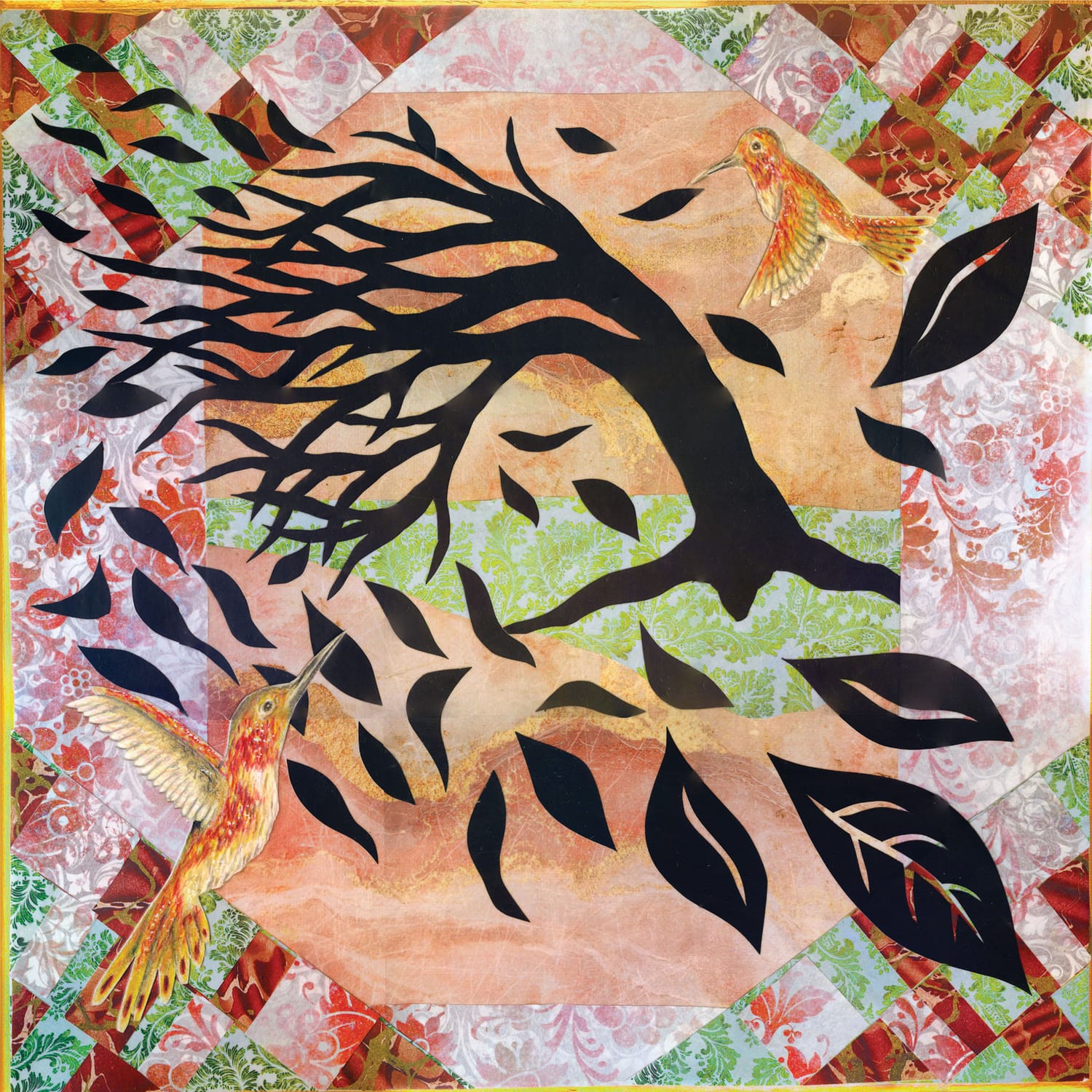
Master the Breeze, bagatelle #1 in E flat major.
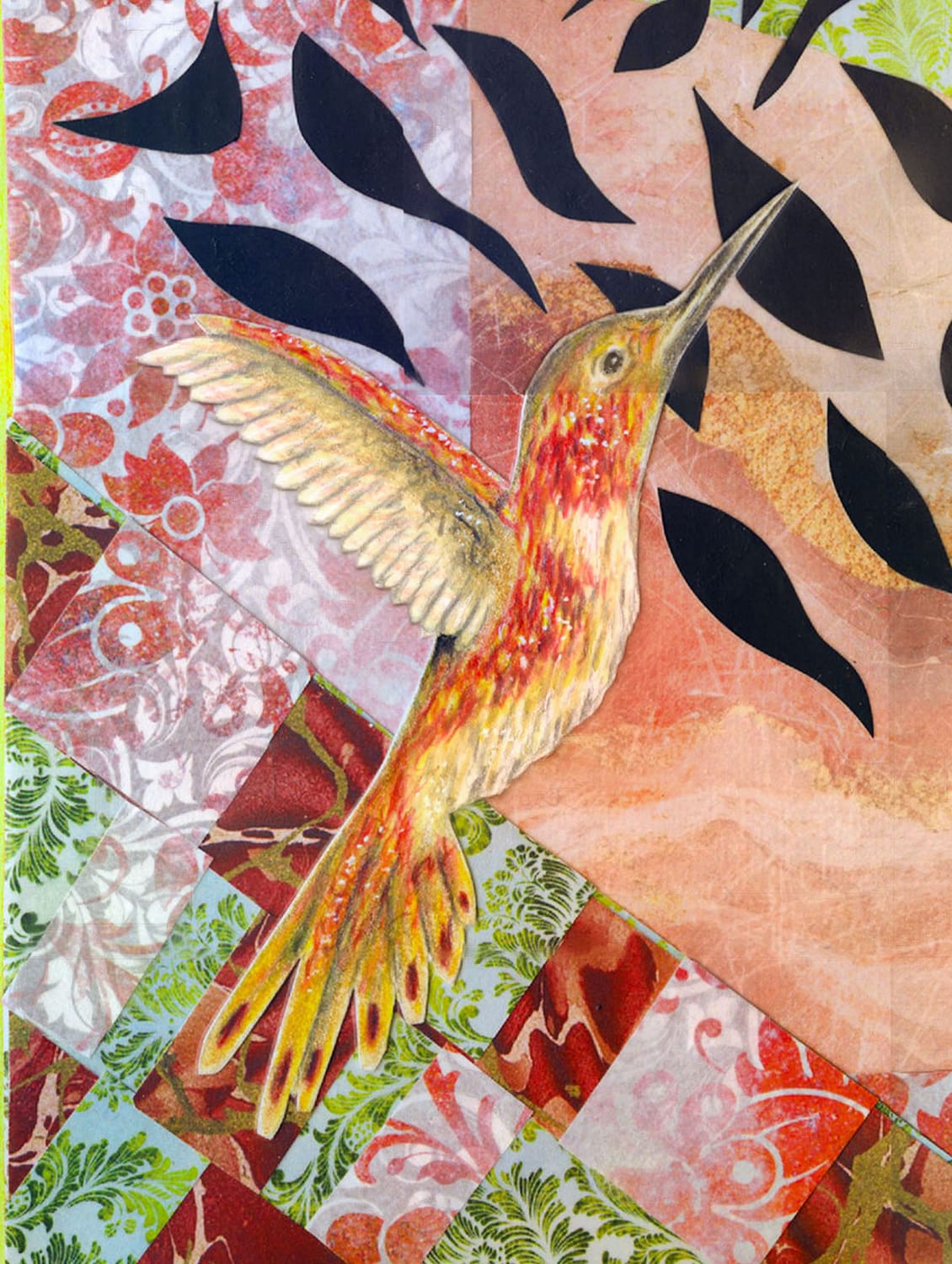
Listen to it here. If we take Goethe’s poem Song of the Spirit Over the Waters seriously then human fate is like the wind. Hummingbirds have learned to hover, making a mockery of the breeze, becoming its masters. The leaves of trees are blown hither and yon, branches toyed with against their will. The hummingbird stands beyond, just watching. Their fate is what they make it.
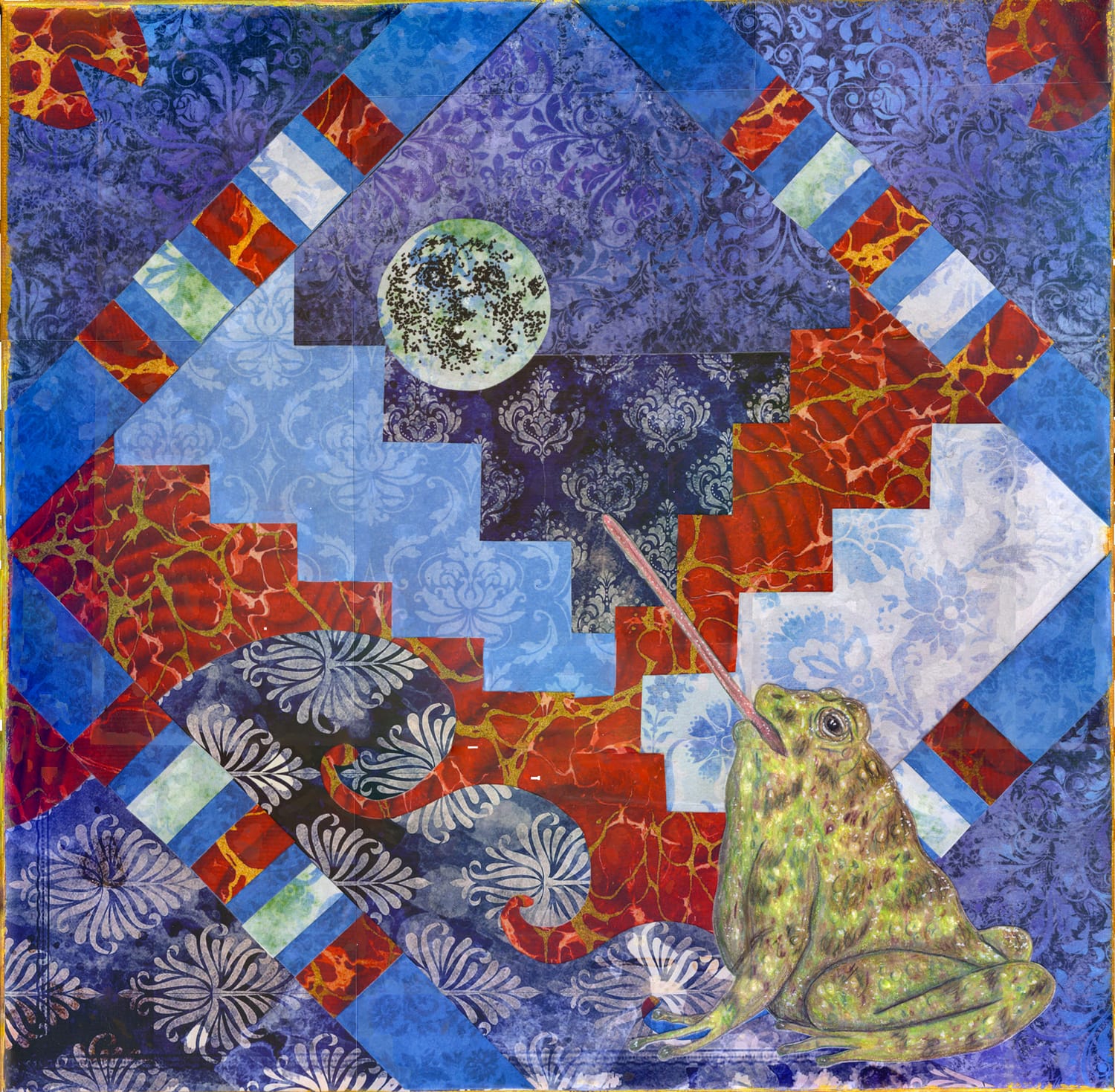
Lunar Leap, bagatelle #2 in C major.
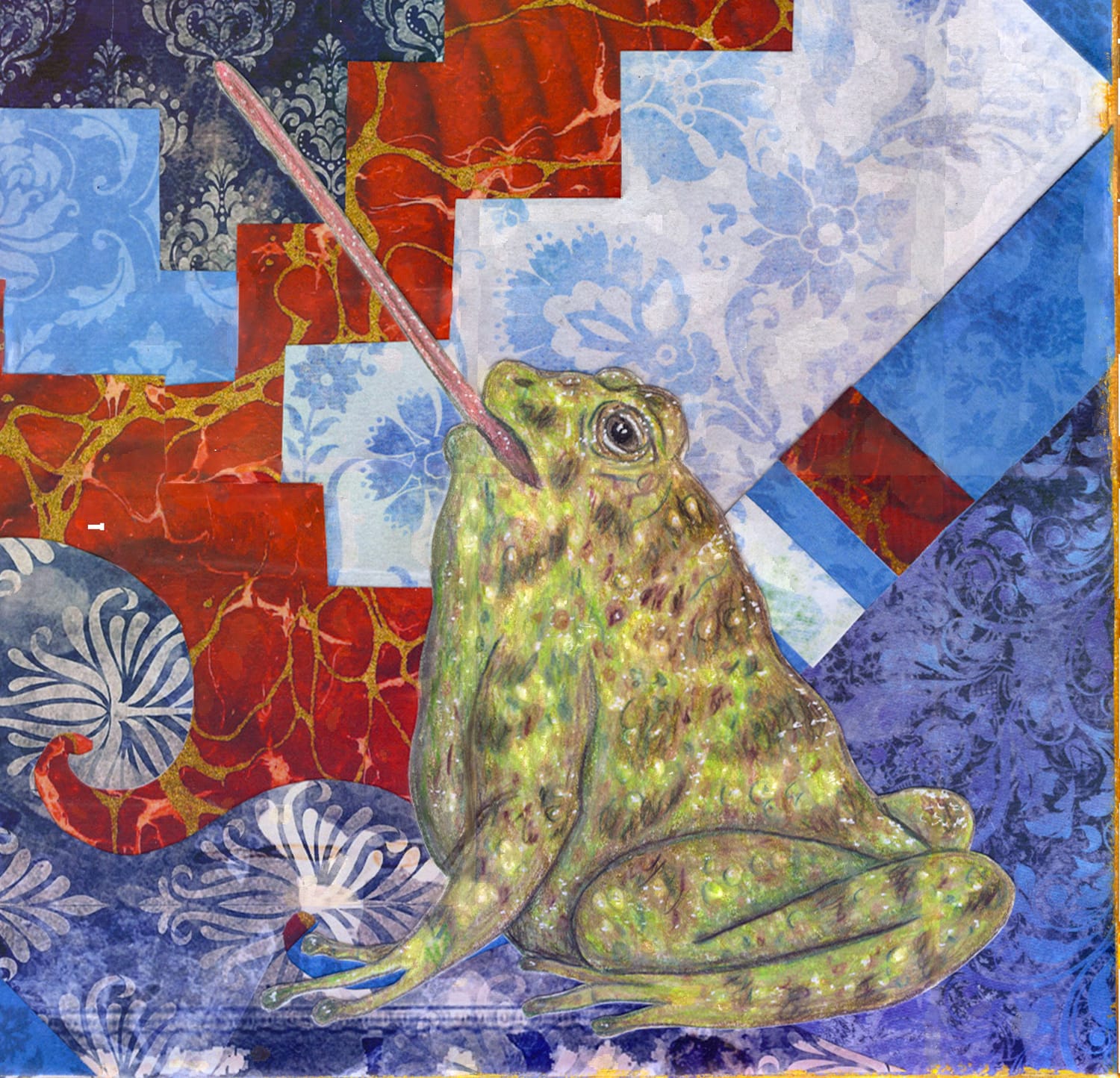
Listen to it here. An accidental depiction of Taoist alchemy where a three legged toad tries to swallow the moon. In Chinese folklore the phases of the moon and eclipses are explained via this metaphor. The toad also plays a role in Taoist alchemy via the legend of the immortal called Liu Haichan, though exactly what this metaphor has to say about the process of achieving immortality remains unclear. I think it means we must enter into a process of giving and receiving the light. We go through phases of absorbing creative influences before creating something ourselves and setting it out into the world. This is how the artist becomes immortal.
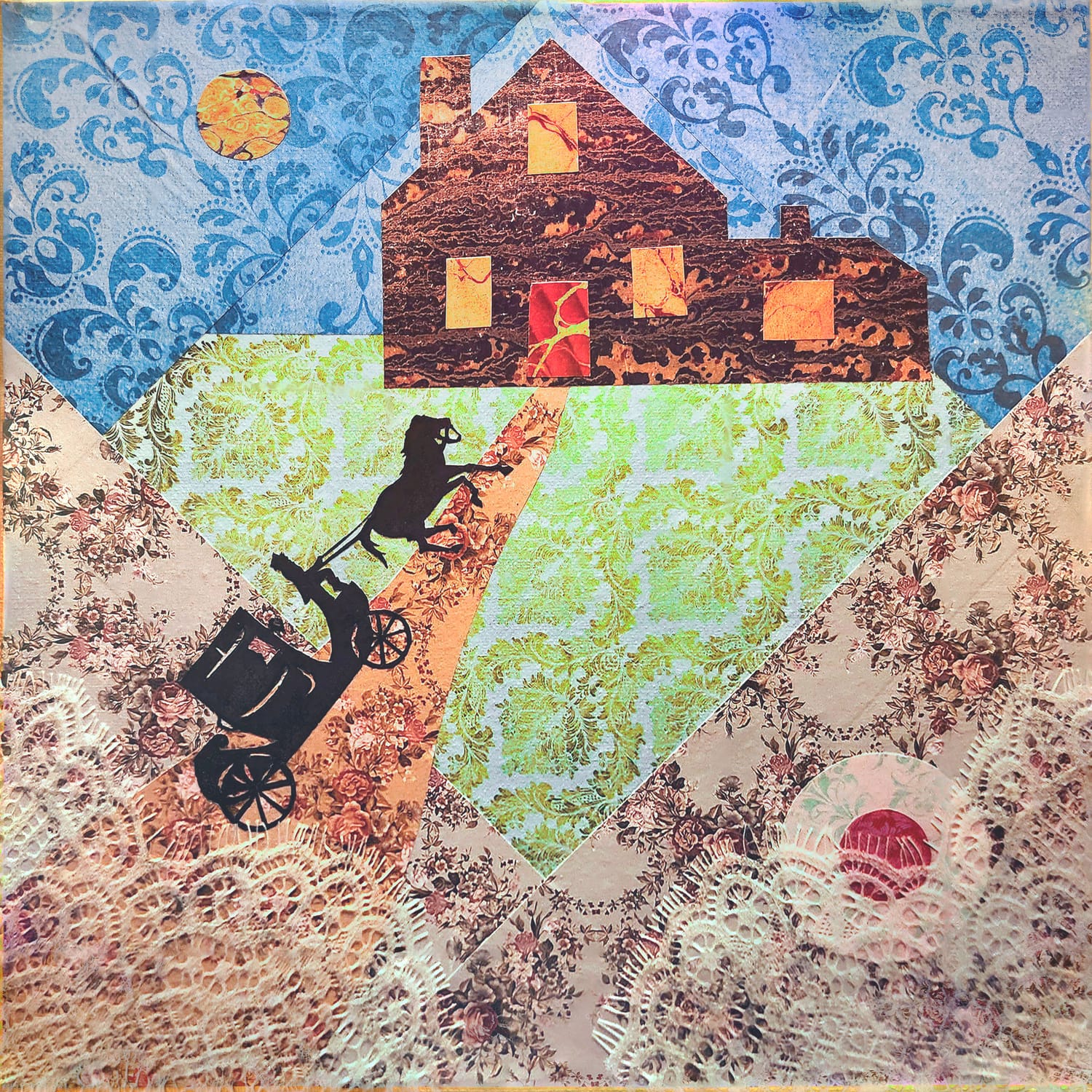
Traveling Lullaby, or Baby’s Continental Breakfast,
bagatelle #3 in F major.
Listen to it here. A vision of a wet nurse nursing a baby in the back of a carriage on their travels. This collage includes real lace that becomes visible or invisible depending on the angle. The nipple of the wet nurse is only half hidden behind this lace, and reflected in the sun in the sky. How did breasts become sexualized anyway when they’re meant to feed babies? How did Beethoven’s era see breasts? Hint: not as sexual as we see them in America today.
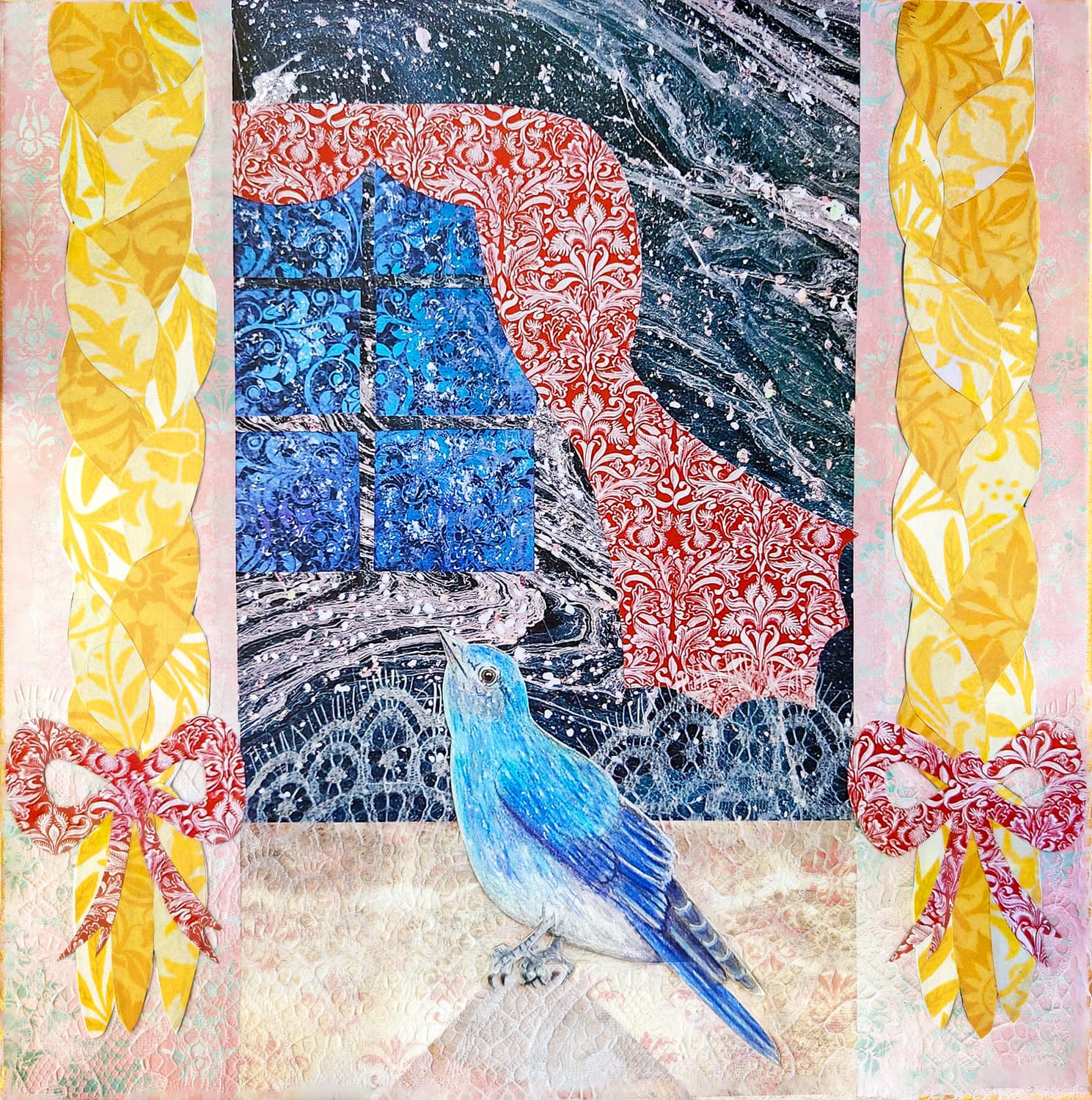
Bluebird Dreams of Snow, bagatelle #4 in A major.
Listen to it here. This is a depiction of innocence dreaming of experience. The music takes the form of a French musette, meant to evoke a very ancien regime idea of “innocent country folk” dancing. This collage depicts two blonde braids in a little girl’s pink bedroom, her bed fringed with real lace. She lives a very sheltered life, but her soul is a mountain bluebird dreaming of getting lost in a snowstorm at night.
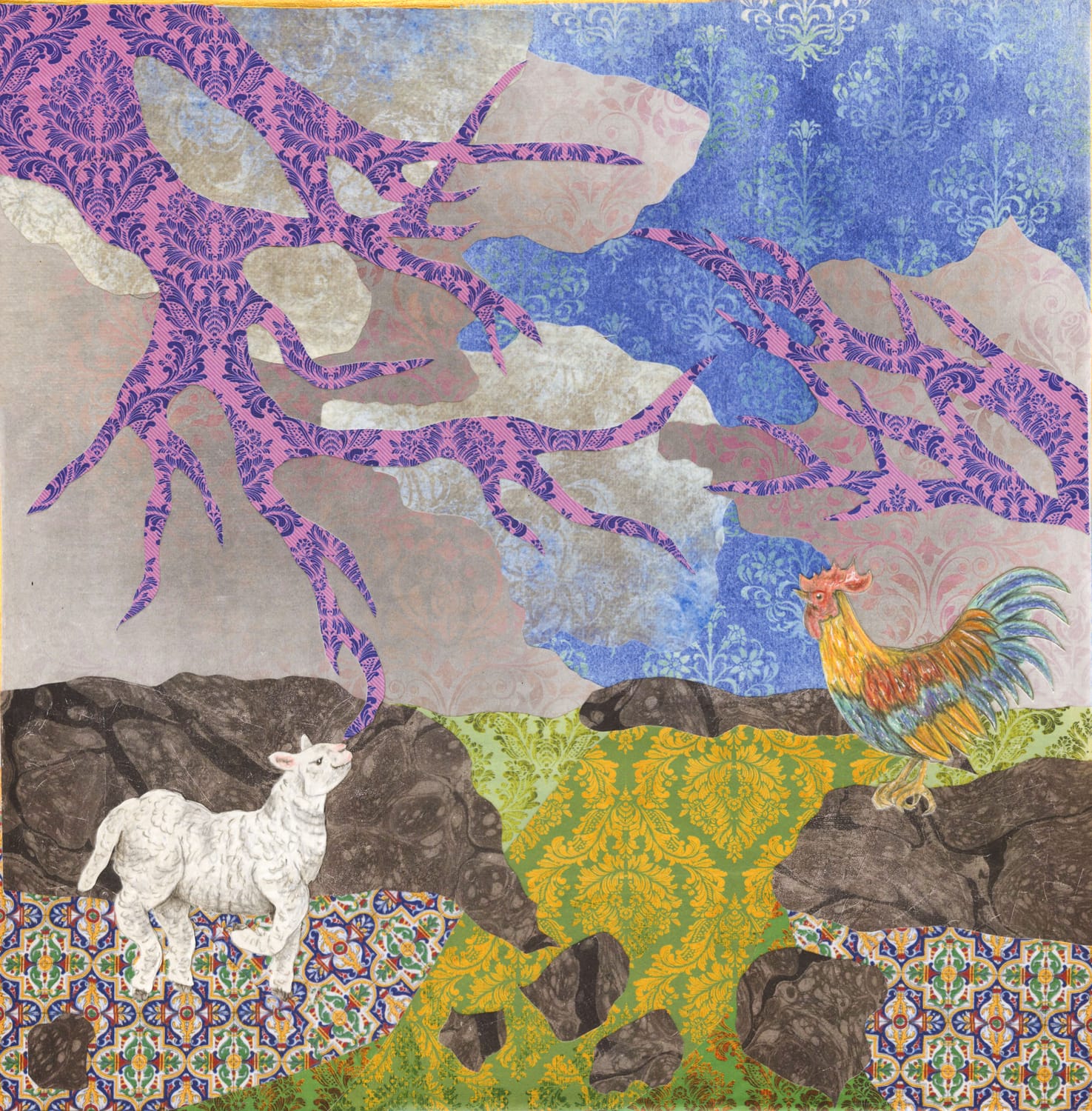
Rules of the Barnyard, bagatelle #5 in C major.
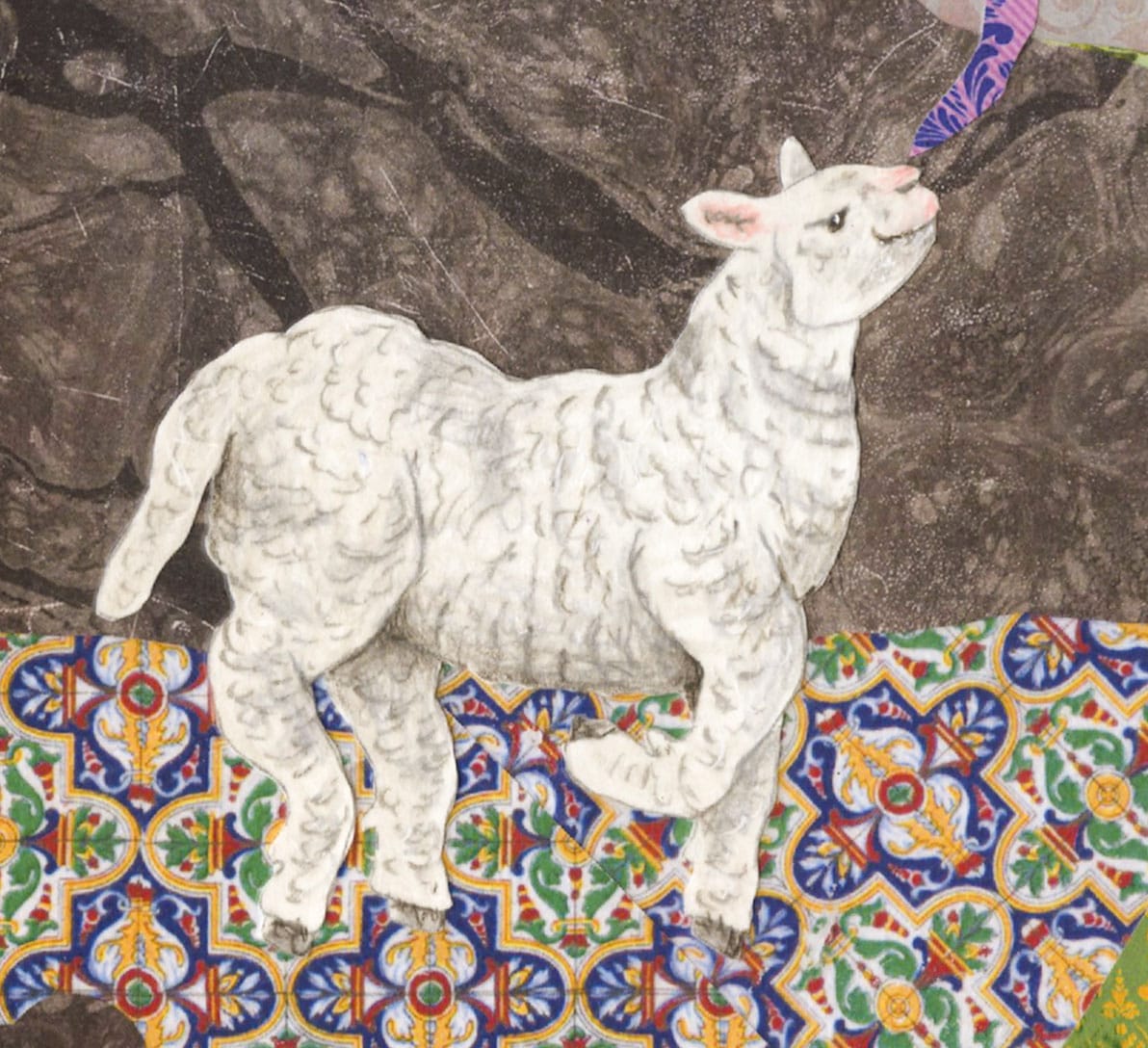
Listen to it here. A rooster has broken down a stone fence in an Irish pasture. While the rooster is ready to explore the fields beyond, the sheep is content to sniff the purple trees on his side of the fence. This collage represents how creativity requires limitations, but we need holes in the wall. Limitations can only feel freeing if we don’t think we’re bound by them. There’s a moment in the music, a continuously repeated note, that sounds very much like a chicken too.
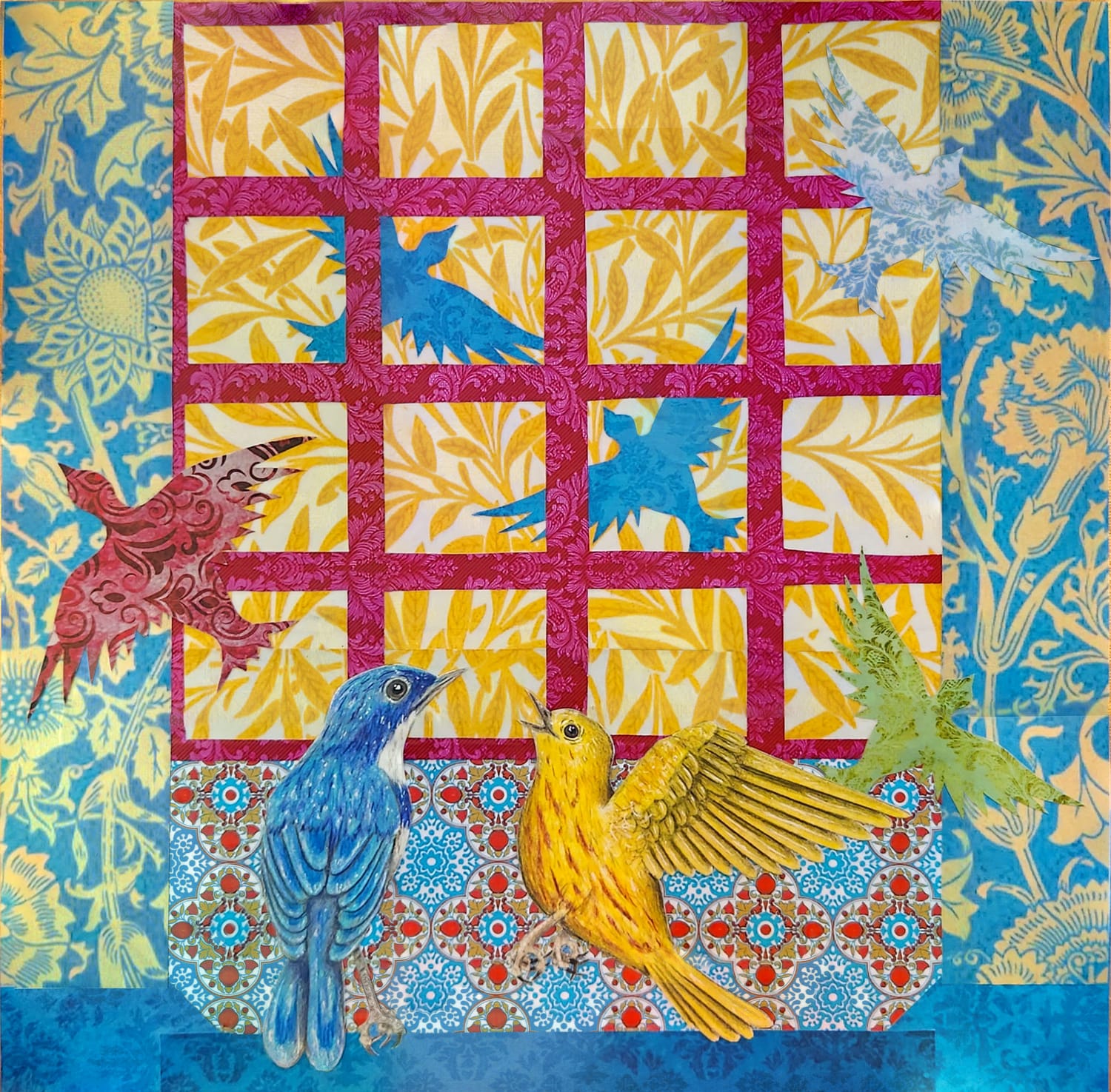
A World Beyond Perfection, bagatelle #6 in D major.
Listen to it here. As much as we require limitations to bring out our best creative work, we can often feel hemmed in by our own maladaptive perfectionism. These two birds long to be free to play outside with the other birds, wild and allowed to make mistakes. Instead they’re stuck inside an immaculate and luxurious home, and hating every minute of it. Other birds who have been outside voluntarily returned to what once felt like a beautiful prison.
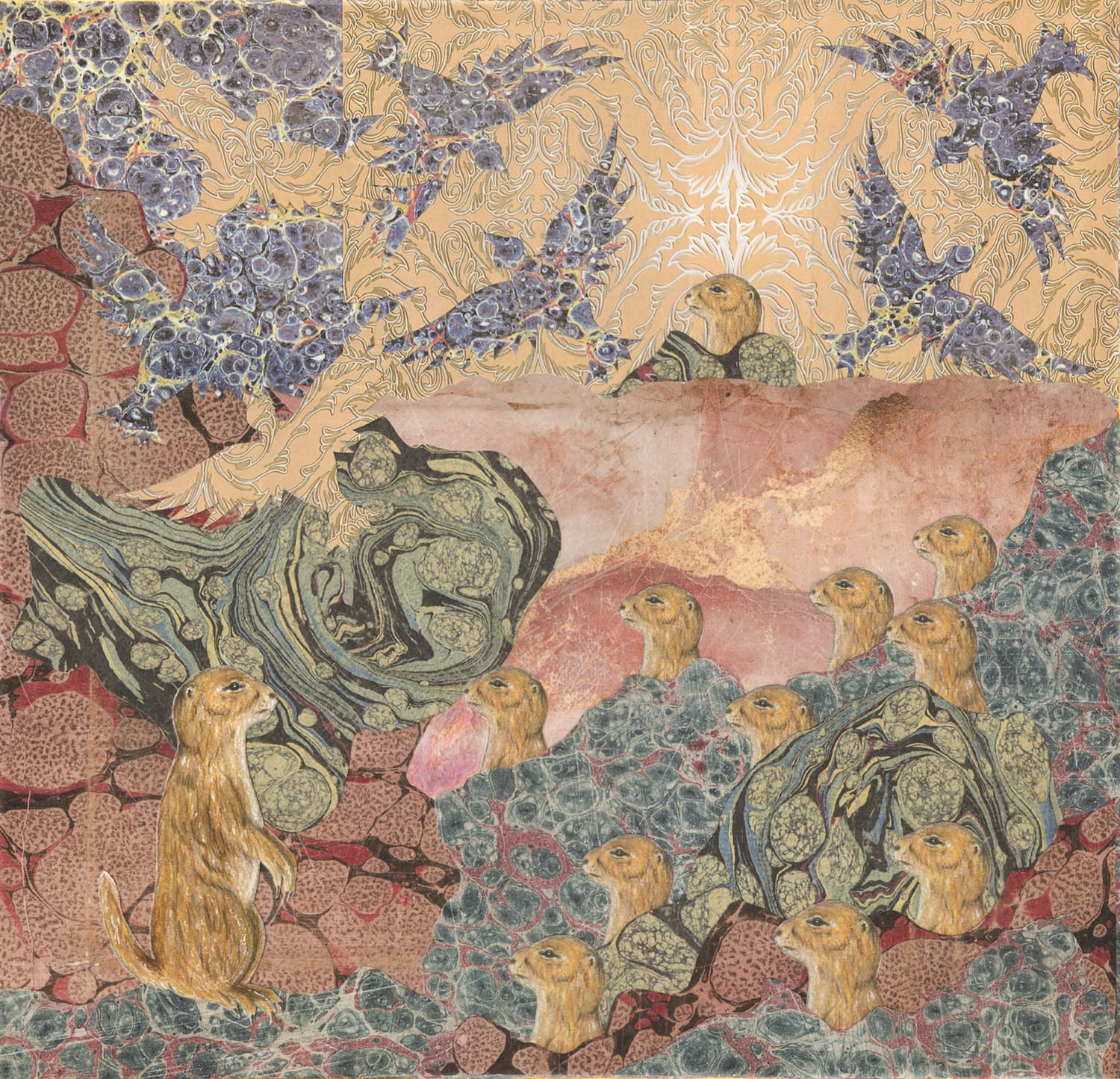
Prairie Dog Proliferation, bagatelle #7 in A flat major.
Listen to it here. You are a theme and variations, constantly growing and evolving throughout your life. This prairie dog sees himself reflected among the rocks over and over again, in various perspectives. Rocks being a very un-prairiedog-like environment. he's probably marveling at just how far he's come. According to the block theory of the universe all of time is happening simultaneously, which means every version of yourself exists now. What advice would you give your past self? Do you ever feel like you receive advice from your future self?
These are the seven pieces in the Little Nothing series, but as we can see they each mean a lot more than nothing. Sometimes seemingly trifling pieces can pack a profound punch.
© Created with systeme.io